
Purple Cow for the feed: Seth Godin's big idea, applied to brands in Muscat
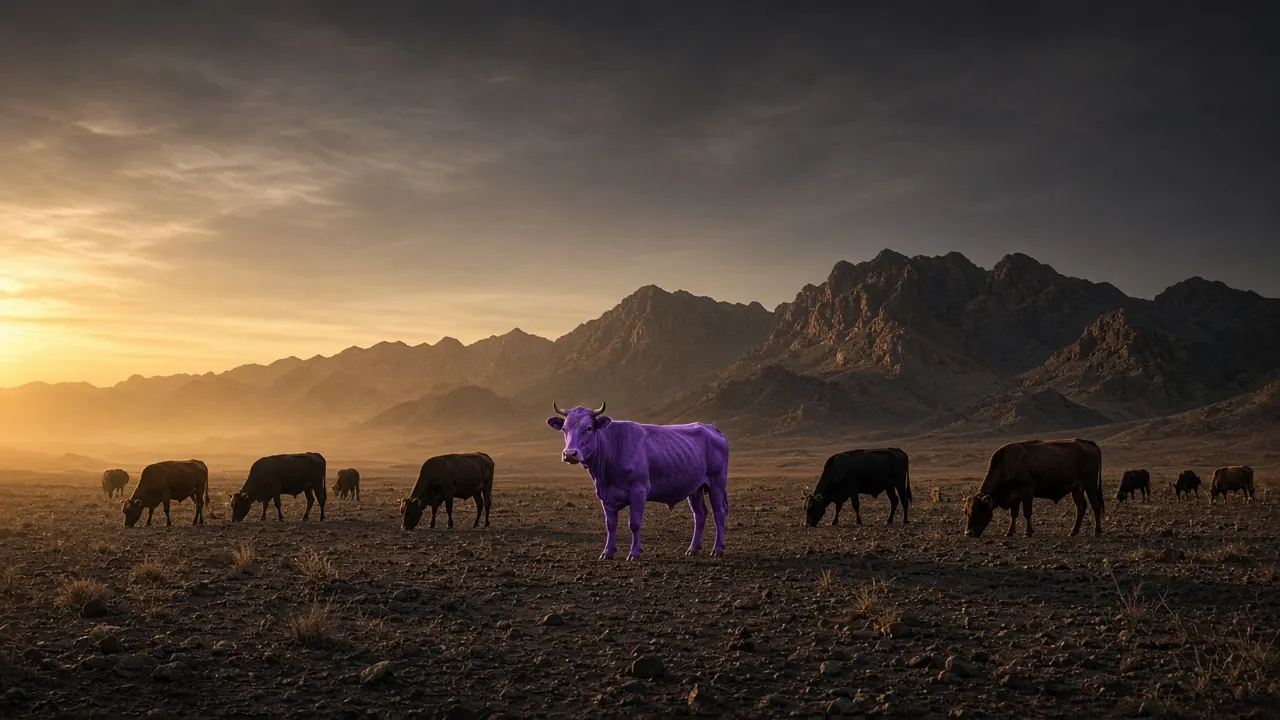
Picture a long drive past fields of cows. The first few are charming. After twenty minutes you stop looking. Brown cow, black cow, another brown cow. Now picture a purple cow. You’d point at it, take a photo and tell someone about it that evening.
That’s the central image of Seth Godin’s book Purple Cow: Transform Your Business by Being Remarkable (2003). It came out years before Instagram Reels existed, but it describes the feed almost exactly. Here’s the short version, and how we use it when we make content for brands in Muscat.
The big idea: “very good” is invisible
Godin’s argument is simple. Most products and most marketing are very good: well made, nicely designed, perfectly fine. And that’s the problem. People have more choices than ever and less time to notice them. They are very good at ignoring things.
In his framing, the opposite of remarkable isn’t bad. It’s very good. Remarkable literally means worth making a remark about: something people choose to talk about, share or send to a friend.
Swap “cows” for “posts” and you have every Instagram feed in Oman. Another clean product shot on a beige background. Another “Happy weekend” graphic. Another polite promo. Nothing is wrong with any of them. They just don’t get noticed.

Why “safe” is the risky option
Godin also points out the old model: buy enough attention (TV, billboards, ads), shout to everyone, and sales follow. He argues that model has been breaking down, because people tune out messages they didn’t ask for.
The trap he describes is that being boring feels safe. Nobody gets fired for a neat, predictable campaign. But if nobody notices it, you’ve spent the budget and got nothing back. For a brand in Muscat competing with global accounts in the same scroll, blending in is the expensive choice.
Build the cow into the product, then film it
One of the most useful ideas in the book is that marketing isn’t something you add at the end. The remarkable part should be designed into the product or the experience itself.
For social content, that changes the brief. Don’t ask “how do we advertise this café?” Ask “what here is worth filming?”
- A restaurant with a dramatic serving ritual has a reel ready to film. A restaurant with a nice menu has a photo.
- A perfume brand that lets you smell the story (raw ingredients, the making, a surprising demo) has more to show than one with a bottle on a plinth.
- A clinic where the doctor explains one honest, useful thing in 30 seconds earns more trust than ten stock images of smiling people.
Our job in content production is often to find the purple cow that’s already inside a business. Then we light it, frame it and cut it so it lands in the first seconds.
Talk to the people who care (and share)
Godin says you shouldn’t try to please everyone. Aim at the people who are actively looking for something new and love telling others about it. He calls them sneezers: people who spread ideas. Once they’re on board, they carry the message to everyone else.
In Muscat that might be the coffee crowd who try every new spot, the hikers who post every wadi, the expat parents who swap recommendations in group chats, or the car community. Content made for one of these groups, in their language and with their references, travels further than content made for “everyone in Oman”.

A Muscat-ready purple cow checklist
We run every content idea through four questions before a shoot:
- Would anyone remark on this? If the honest answer is “it’s nice”, it isn’t ready yet. Push the idea until it’s specific, surprising or useful.
- Does it earn the first 3 seconds? The remarkable moment goes first. Put the reveal, the ritual or the bold claim up front, not after a logo.
- Can it become a format? One clever reel is luck. A repeatable series (same hook, new episode) is a system people come back for.
- Is there a reason to share? Make it funny, useful, beautiful or local enough that someone sends it to a friend with “we have to go here”.
The takeaway
Purple Cow isn’t about being loud or weird for the sake of it. It’s about deciding, on purpose, to make something worth talking about, and then making content that shows it clearly. In a fast-growing market like Muscat, where many brands still post “very good” content, that’s a real opening.
Want to know if your Instagram has a purple cow, or just a lot of brown ones? Ask us for a free Instagram analysis. We’ll send you a short, honest report on WhatsApp.
Summary and commentary by the NoOr team, based on Seth Godin’s book Purple Cow (2003). Ideas are paraphrased, not quoted.